BACKGROUND
the potential of ai for education certainly opens up many different perspectives that need to be considered in the context of learning. given the complex role that technology has played over the years in creating expectations around its ability to support teaching and learning, for example, headphones to, the internet, smart devices, and moocs, each iteration brings a level of optimism and will be a technological advancement that changes the face of education (escueta et al.,2017). higgins (2012), states that this optimism needs to be examined further from the perspective of techno-solutionism, a perspective that emphasizes a critical examination of the role of technology and its limitations in solving societal problems. furthermore, ai has emerged as a disruptive technology that has the capacity to revolutionize certain educational endeavors, such as in essay writing or the facilitation of (hybrid) learning approaches (jarvela, dkk. 2023).
the system is a combination of artificial and human intelligence, which of course has the potential to improve the pedagogical process by providing support for teaching and learning activities, (chan, 2022). ai as a technology has the capacity to revolutionize the process of knowledge creation for various educational stakeholders, including students, and society as a whole. through this, ai has the potential to not only be incorporated into hybrid systems designed to foster student agency and creativity, but also to facilitate the personalization of the learning process, (chen, m. h. 2023) as ai systems develop, it appears that the relationship between humans and ai has evolved beyond process automation to a more collaborative partnership based on synergies and shared strengths and the metacognitive potential of human–ai collaboration (leroy, a., & romero, m. 2023).
this is where ai has the potential to educate, train, and improve human performance, so that they can work better in their tasks and activities (stephen, jh, dkk. 2021). so the common thread that can be drawn is that 1) simulation is one of the most effective ways to facilitate learning of complex skills in various domains. 2) various types of roles can facilitate simulation-based learning during various phases of knowledge and skill development (chernikova, dkk, 2020). more specifically, artificial intelligence not only helps education academically and administratively, but also increases its effectiveness. artificial intelligence provides assistance to teachers in various types in the form of learning analytics, virtual reality, assessments/ grading/assessments, and acceptance (ahmad, dkk, 2022).
where this is in line with the statement of luan, dkk (2020). he stated that "artificial intelligence has the potential to educate, train, and improve human performance", then the use of ai can improve human welfare through education. therefore, to build a digitally resilient and inclusive education system based on technology requires a cross-disciplinary framework that combines ethics, public policy, critical social theory, and educational spirituality. ai technology must be understood as a product of social and power relations shaped by logic, knowledge, and cultural structures. therefore, digital resiliency and ai for education cannot be separated from the macro discourses about digital justice, data sovereignty, and the purpose of education itself in forming human beings who are intact intellectually, morally and spiritually.
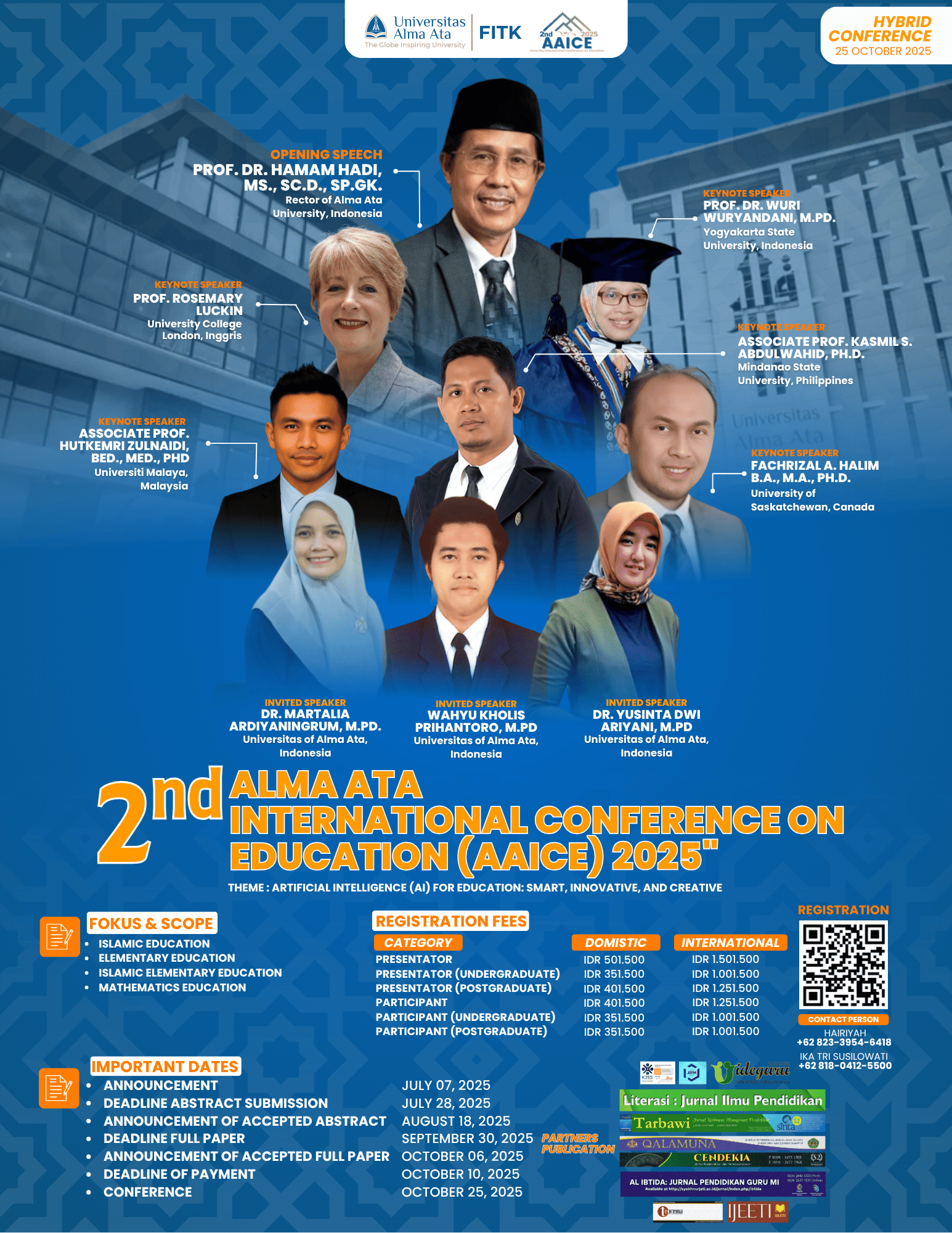
OPENING SPEECH

Prof. Dr. H. Hamam Hadi, MS., Sc.D., Sp.GK.
Rector of Alma Ata University, Indonesia
KEYNOTE SPEAKER
Prof. Dr. Wuri Wuryandani, M.Pd.

Yogyakarta State University, Indonesia
Prof. Rosemary Luckin

University College London Inggris
Fachrizal A. Halim B.A., M.A., Ph.D.

University of Saskatchewan, Canada
Associate Prof. Kasmil S. Abdulwahid, Ph.D.

Mindanao State University, Philippines
Associate Prof. Hutkemri Zulnaidi, BEd., MEd., PhD

Universiti Malaya, Malaysia


INVITED SPEAKER
TOPICS COVERAGE
Islamic Education
- Curriculum in Islamic Education
- Learning Media in Islamic Education
- Learning Technology in Islamic Education
- Assessment & Evaluation in Islamic education
- Management in Islamic education
- other themes related to Islamic education
- AI in Islamic Education
Elementary Education
- Curriculum in Elementary Education
- Learning Media in Elementary Education
- Learning Technology in Elementary Education
- Assessment & Evaluation in Elementary education
- Character Education
- other themes related to Elementary education
- AI in Elementary Education
Mathematics Education
- Curriculum in Mathematics Education
- Models, methods, learning strategies in Mathematics Education
- Learning media in Mathematics Education
- Learning technology in Mathematics Education
- Assessment & Evaluation in Mathematics Education
- Higher Order Thinking Skill in Mathematics Education
- AI in Mathematics
- Ethnomathematics
- STEM/STEAM Education
FLYER
DAFTARKAN SEKARANG JUGA
DAFTARTIMELINE
| Announcement | 07 July 2025 |
| Deadline Abstract Submission | 19 September 2025 |
| Announcement of Accepted Abstract | 30 September 2025 |
| Deadline Full Paper | 06 October 2025 |
| Deadline of Payment | 10 October 2025 |
| Conference | 25 October 2025 |
| Off | 26 October 2025 |
© Copyright 2025 CISDT UAA